The best tombs in the Valley of the Kings, and which three to pick with a standard ticket
The best tombs in the Valley of the Kings, and which three to pick with a standard ticket
A standard Valley of the Kings ticket lets you into three tombs from the rotation open that day, and the choice matters. Our default pick for a first visit is Ramesses IV (KV2) for the color, Merenptah (KV8) for the scale and Tausert and Setnakht (KV14) for the story, plus one separate ticket: Ramesses VI (KV9) if you add only one, Seti I (KV17) if you want the finest tomb in Egypt. Tutankhamun (KV62) is small and plain, and unforgettable because the king is still in it. Open tombs change without notice, so read this as a ranked list and check the board at the gate.
How the ticket system decides what you see
The general admission ticket covers three tombs, chosen from a list of roughly eight to ten that the antiquities authority keeps open at any one time. That list rotates, so a tomb open last winter may be resting this winter while its paint recovers, and nobody can promise you a specific tomb. Check which are open on the board by the ticket windows, and decide there.
Three tombs sit outside that rule and each needs its own extra ticket from the same windows: Ramesses VI (KV9), Seti I (KV17) and Tutankhamun (KV62). The tomb of Ay in the West Valley is a separate site a short drive away. None of these count against your three.
For opening times, the tram, what to carry and how the windows work, read our guide to Valley of the Kings tickets and logistics. This page is about the tombs themselves and which three go together.
The standard-ticket tombs, one by one
These are the tombs that most often appear on the general admission rotation. Usually five or six of them are open on a given morning, and the order below runs roughly from the tram stop up the valley.
Ramesses IV (KV2)
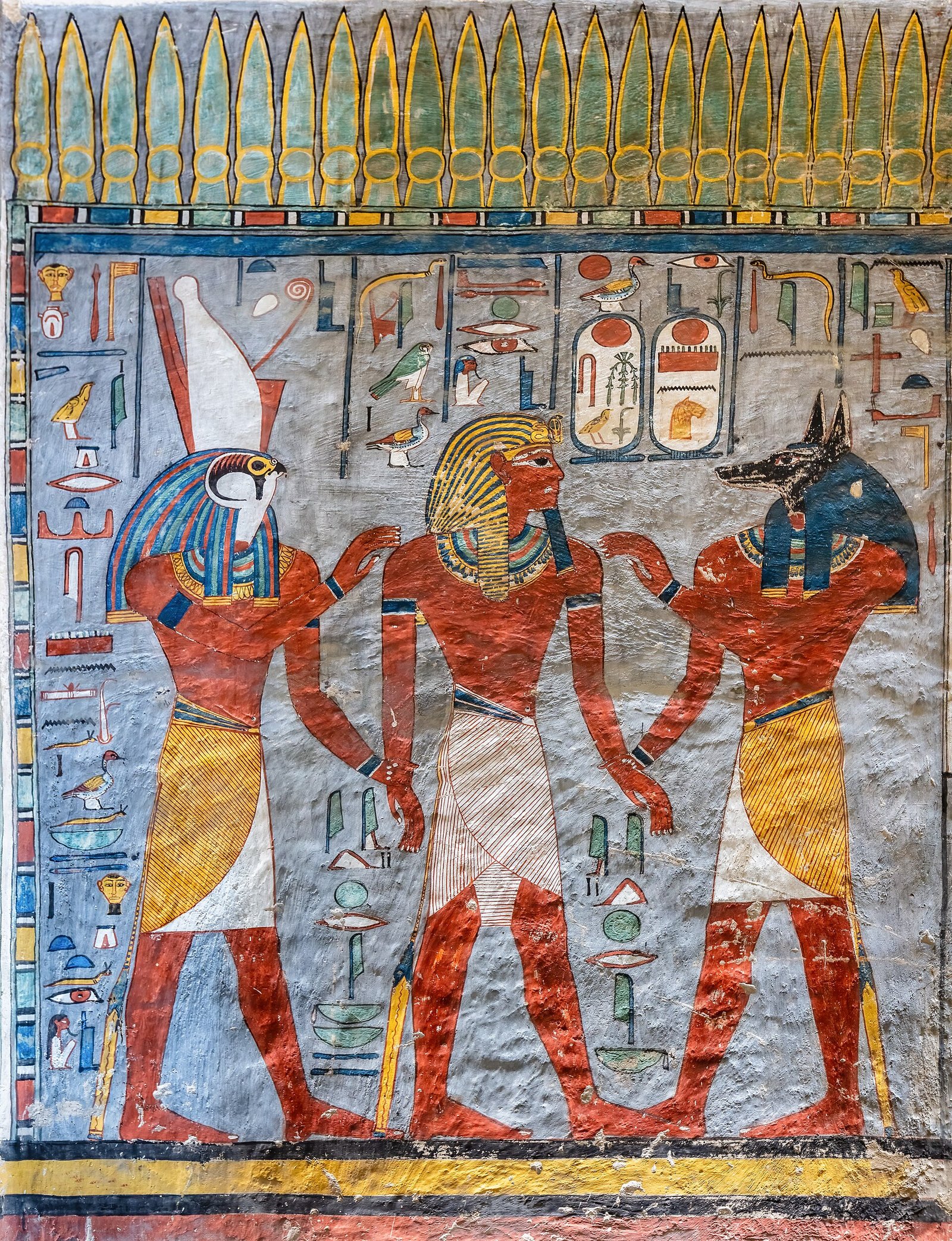
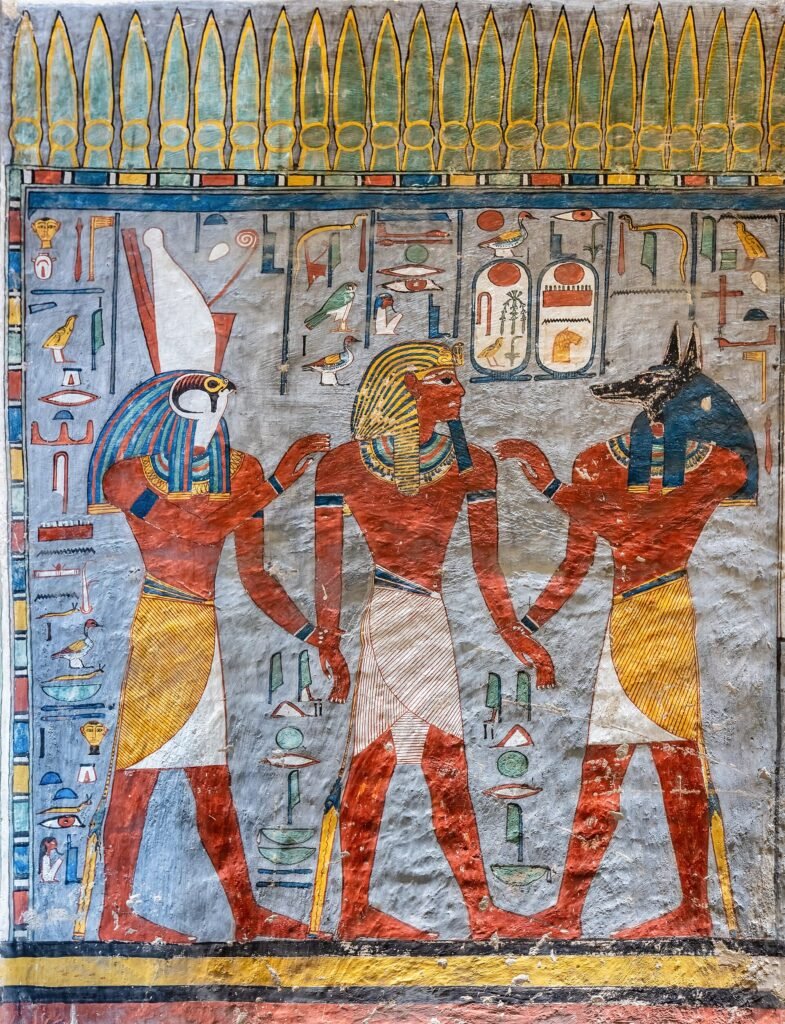
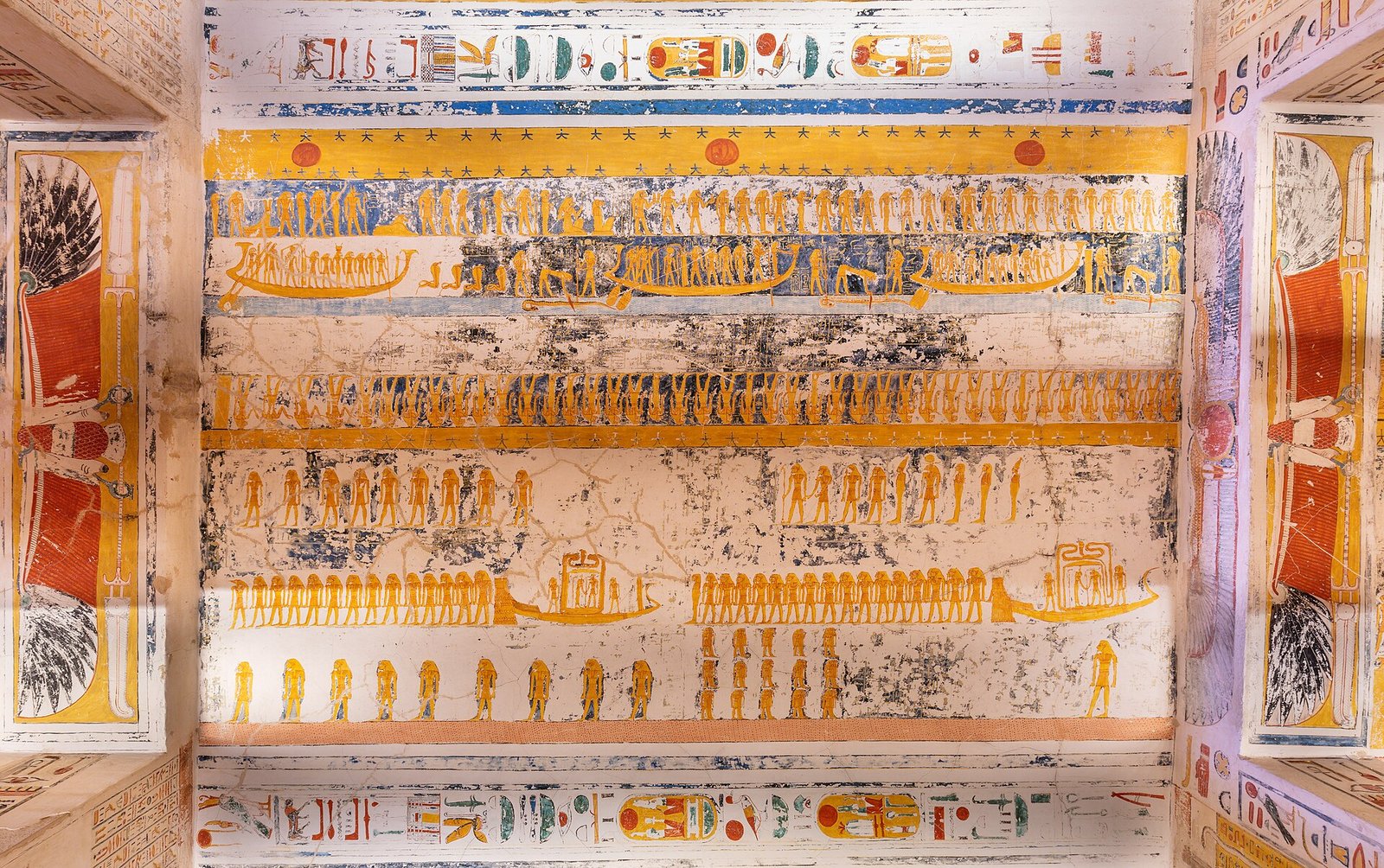
The first tomb on the left from the tram stop, short, wide and almost flat, with a ramp instead of stairs, and the one we send anyone with tired knees into first. The burial chamber ceiling shows the sky goddess Nut stretched twice across the vault, swallowing the sun at dusk and giving birth to it at dawn, in blue and gold that still reads clearly. A huge pink granite sarcophagus fills the room, and Greek graffiti near the entrance prove it has had tourists for two thousand years.
Ramesses IX (KV6)
Also near the entrance, also gentle, and often the most crowded tomb in the valley for exactly that reason. The scenes in the first corridors are among the sharpest anywhere, the king before Re-Horakhty and long passages from the Book of the Dead. The burial chamber was finished in a hurry, painted rather than carved, under a fine astronomical ceiling. Go in first or go in last.
Merenptah (KV8)
The son of Ramesses II built a tomb that feels twice as big as it is. A long straight descent, steeper than the first two, ends in a burial chamber holding the lid of an enormous granite sarcophagus carved with the king's figure, while the outer lid rests in a corridor above, where the ancient robbers abandoned it. Floods damaged the lower part, but the sense of scale is the best you get without a separate ticket.
Ramesses III (KV11)
Nicknamed the Tomb of the Harpers after two blind musicians painted in a side room. It is one of the longest tombs in the valley and the strangest at the start: the side chambers show bakers, butchers, boats, weapons and royal furniture instead of gods, which no other royal tomb does. Halfway down, the corridor jogs right because the diggers broke into the neighboring tomb. The lower sections are often closed, so you may see only the upper half. Still worth one of your three.
Tausert and Setnakht (KV14)
The best story in the valley. Tausert, a queen who ruled in her own right at the end of the nineteenth dynasty, began this tomb for herself. Setnakht, founder of the next dynasty, took it over, plastered over her images, cut his own and added a second burial chamber deeper in. Where the plaster has fallen you see the queen's slim figure under the king's. Two burial chambers and one of the longest walks in the valley, on a slope you barely notice.
Siptah (KV47)
A young king who reigned briefly and whose mummy shows a withered foot. His tomb is a long, straight, mostly undecorated corridor, which sounds like a reason to skip it and is actually a reason to consider it: the first stretch is beautifully carved, then you walk in near silence to a rough chamber with a broken sarcophagus. When the front tombs are heaving with cruise groups, Siptah is often empty.
Others come and go on the rotation: Ramesses I (KV16), tiny and vivid, and Thutmose III (KV34), up a steep cleft in the cliff, with unique cursive decoration. Ramesses II (KV7) and the tomb of his sons (KV5) are not open.
The three separate-ticket tombs
Ramesses VI (KV9): the one to add if you add only one
Long straight corridors, a gentle slope, and decoration on every surface: the Book of Gates and the Book of Caverns on the walls, the Book of the Earth in the burial chamber, and on the vaulted ceiling the sky goddess Nut twice over, the hours of the day along one body and the hours of the night along the other. The huts of the workers who dug it buried the entrance to Tutankhamun's tomb next door, which is why that one survived.
Seti I (KV17): the finest tomb in Egypt
Found by Belzoni in 1817, closed for decades while its walls were stabilized, and now open on its own ticket. It is the longest and deepest of the royal tombs and the only one where the relief carving was finished and painted from the entrance to the burial chamber. Its astronomical ceiling is the model Ramesses VI copied. The alabaster sarcophagus is in London, so the chamber is empty. The descent is real: long staircases, a deep well shaft crossed by a bridge, and a hot climb back up. Budget most of an hour.
Tutankhamun (KV62): small, plain and unlike any other
Four small rooms, one of them decorated, at the bottom of a short staircase. The treasures are in the Grand Egyptian Museum in Giza; the tomb holds the quartzite sarcophagus, the outermost gilded coffin, and the mummy of the king himself, in a climate-controlled glass case in the room where Howard Carter found him. The painted wall shows Ay performing the Opening of the Mouth for the dead boy. If you are here for the walls, spend that ticket on Seti I instead.
Ay and the West Valley
The West Valley branches off the road before the main entrance and has its own small ticket office. The tomb you can visit belongs to Ay, the elderly courtier who succeeded Tutankhamun and who appears on the boy king's burial chamber wall. Ay's own chamber is painted by what look like the same hands, plus a scene of the king hunting in the marshes that appears in no other royal tomb. His face and name were hacked out later.
The point of the West Valley is the silence: a bare, wide wadi, almost nobody in it and a long stairway down. If you saw the main valley on a previous trip, or want one place with no tour groups at all, this is the hour.
Length, stairs and heat: what each tomb asks of your legs
Every tomb is warmer than the air outside, with no ventilation, and in summer the valley sits above 104 F (40 C) by late morning. Lower sections open and close.
| Tomb | Walk inside | Slope and stairs | Who it suits |
|---|---|---|---|
| Ramesses IV (KV2) | Short | Gentle ramp, almost no steps | Everyone, limited mobility, hot days |
| Ramesses IX (KV6) | Short to medium | Gentle ramp | Everyone, but crowded mid-morning |
| Merenptah (KV8) | Long | Steep straight descent, stairs and ramps | Fit walkers who want scale |
| Ramesses III (KV11) | Long, upper part usually | Modern stairs at the entrance, then gentle | Most visitors; lower half often closed |
| Tausert and Setnakht (KV14) | Longest of the standard tombs | Gentle and continuous | Anyone with time and an ear for the story |
| Siptah (KV47) | Long | Straight, moderate | Visitors who want quiet |
| Ramesses VI (KV9) | Medium | Gentle | Everyone; the best of the extra tickets |
| Seti I (KV17) | Longest and deepest | Several staircases, a deep well, steep return | Fit visitors with an hour to spend |
| Tutankhamun (KV62) | Very short | One short staircase | Everyone; feels crowded in a small space |
| Ay (West Valley) | Medium | Long stairway down | Anyone who wants an empty valley |
If someone in your group walks with difficulty, the plan writes itself: Ramesses IV, Ramesses IX and, if open, Ramesses I. We cover Luxor's other sites in our guide to Egypt with limited mobility.
Crowds, and the two hours when the valley is yours
The Nile cruise boats send their passengers to the west bank in the middle of the morning, and groups head for the nearest tombs first, which is why Ramesses IV and Ramesses IX can have a line out of the door at ten while Siptah and Tausert, a few minutes further up the path, are empty.
Two windows work. The first is opening time, when the valley is cool and the light on the cliffs is best; be at the gate as it opens, walk past the first tombs to the far ones, and take the near ones on your way out. The second is early afternoon, after the groups have gone back to their boats for lunch; hotter but quieter. Balloon passengers land around sunrise, which puts you at the gate before almost anyone; see our guide to the hot air balloon over Luxor.
The best three-tomb combinations, by what you care about
Add an extra ticket where noted, and substitute freely when a tomb is closed; the principle behind each combination matters more than the names.
- First visit, one shot at the valley: Ramesses IV, Merenptah, Tausert and Setnakht, plus a ticket for Ramesses VI. Color, scale, a story and the ceiling.
- The painted walls and nothing else: Ramesses IV, Ramesses IX, Ramesses III, plus Seti I. This is the art tour; skip Tutankhamun without guilt.
- Three dynasties, three styles: Thutmose III if open, then Merenptah or Tausert and Setnakht, then Ramesses III or Ramesses IX. The shift from sparse early style to wall-to-wall Ramesside color is obvious even on a first visit.
- Limited mobility or a hot day: Ramesses IV, Ramesses IX, Ramesses I if open, and Tutankhamun as the extra, all short and near the tram.
- Kids and teenagers: Ramesses III for the bakers and boats, Merenptah for the giant sarcophagus, and Tutankhamun, because he is the one they know.
- Second visit: Siptah, Tausert and Setnakht, whichever tomb has just come back, then Seti I and the West Valley for Ay.
Photography inside the tombs
The rules change and are posted at the ticket windows, so check on the day. In general terms, photography inside the tombs has required a separate photo permit sold at the same windows, flash and tripods are never allowed, and a few tombs at times restrict cameras entirely. The guards enforce the flash rule strictly because it is the one that damages the paint.
A phone at high ISO does better than a camera with a flash, and the best shots are ceilings, not walls. Never touch the walls or lean on the plexiglass. For drones, museums and photographing people, read our guide to photography rules in Egypt.
How a guide reads the walls for you
Licensed guides are not permitted to lecture inside the tombs, a rule that keeps the corridors moving and the air still. What a good guide does instead is stop at the tomb plan outside the entrance and hand you the key to the walls before you go in.
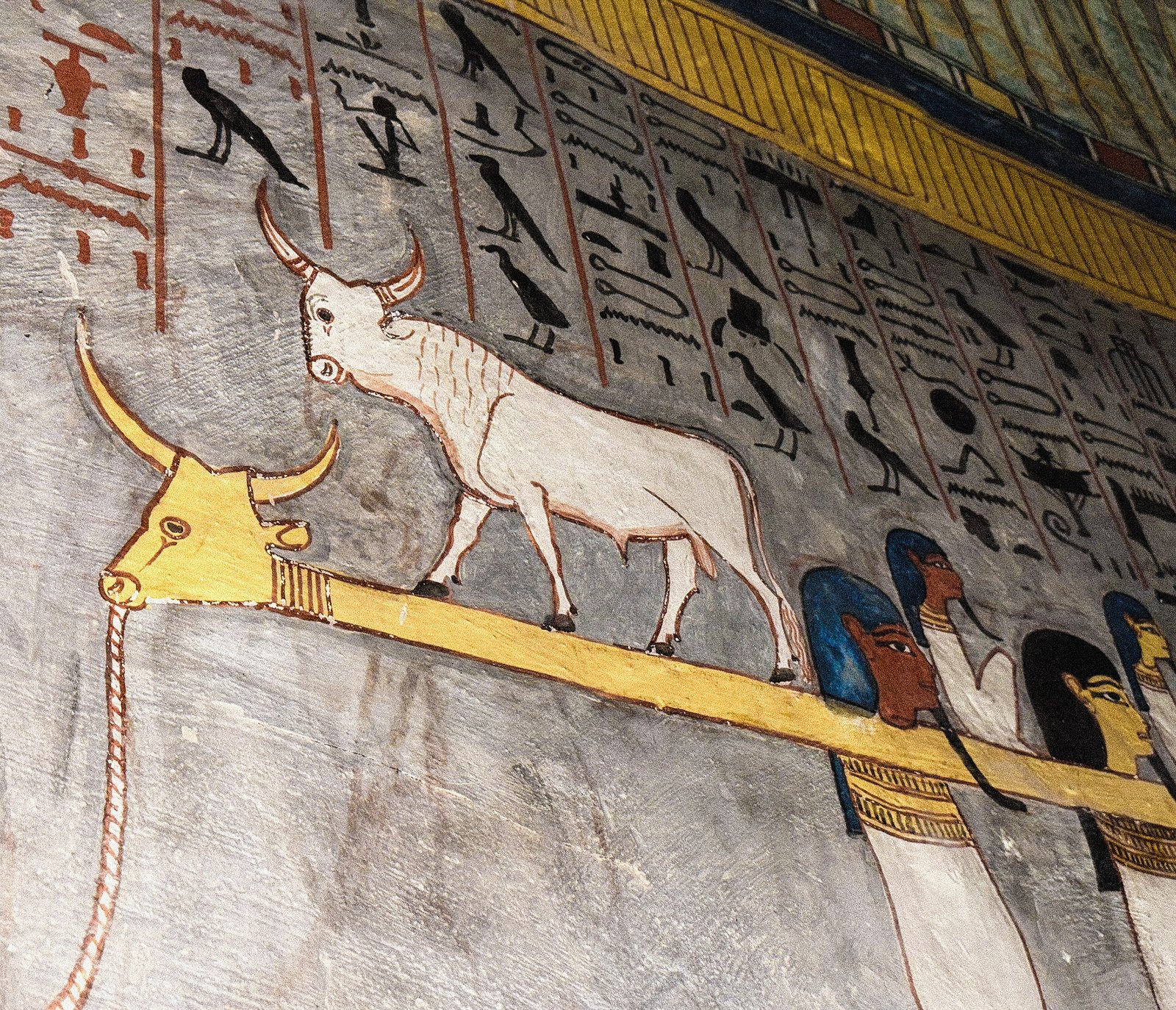
The key is simple. Royal tombs are not decorated with the king's life, as the nobles' tombs are. They carry illustrated religious texts describing the sun's journey through the twelve hours of the night, in the solar boat, past gates, serpents and lakes of fire, until it is reborn at dawn. The king rides with the sun and is reborn with it. The Amduat tells it one way, the Book of Gates another, the Book of Caverns a third, and on the ceiling the goddess Nut arches over everything.
Once your guide has shown you the solar boat in one tomb, you find it in every other, and the repetition that feels monotonous without a guide becomes the point. We wrote a plain introduction to those texts in our guide to the Book of the Dead. The people who painted the walls lived over the ridge at Deir el Medina, the right second stop of the morning.
How Explora Egipto plans the morning
Our west bank day starts at the valley gate as it opens, with your guide already holding the tickets and the separate-ticket tombs decided the evening before, based on what is open. The guide walks you to the far end first, briefs you at each entrance and answers questions in the shade between tombs. Three standard tombs plus one extra takes about two hours; with Seti I, closer to three.
From there the car goes over the ridge to Hatshepsut's temple, or to Deir el Medina and the Tombs of the Nobles if you prefer quiet, then the Colossi of Memnon on the way back. Karnak and Luxor Temple belong to the late afternoon. How the two halves fit is laid out in our guide to Luxor's east bank and west bank, and the full menu in our Luxor excursions.
Tell us who is traveling, how much walking is comfortable, and whether the walls or the boy king matter more, and we build the three-tomb plan around it. Ask us for the quote.
Frequently asked questions
How many tombs can you visit with a standard Valley of the Kings ticket?
Three, chosen from the tombs open that day on the general admission rotation. The ticket is checked at each tomb entrance, and once you have used three you cannot enter a fourth without another general ticket. Ramesses VI, Seti I and Tutankhamun are sold separately and do not count against the three.
Which tombs need a separate ticket?
Ramesses VI (KV9), Seti I (KV17) and Tutankhamun (KV62) inside the main valley, each bought at the same windows as the general admission, and the tomb of Ay in the West Valley, which has its own office. If you add only one, choose Ramesses VI for the ceiling; if you want the finest tomb in Egypt, choose Seti I and allow an hour.
Is Tutankhamun's tomb worth the extra ticket?
It depends on what you came for. The treasures are in the Grand Egyptian Museum, the tomb is four small rooms and only the burial chamber is painted. What you get is the king himself, lying in a glass case where Howard Carter found him, and many people find that quietly overwhelming. If you care more about painted walls than about history, spend the money on Seti I.
Which tomb is best for someone who cannot manage stairs?
Ramesses IV (KV2), first on the left from the tram stop, short and almost flat with a ramp instead of steps. Ramesses IX (KV6) is nearly as easy, and Ramesses I (KV16), when open, is tiny. Avoid Merenptah, Seti I and Thutmose III, which have long or steep descents. Tell us in advance and your guide plans the three around the tram stop.
Why is the tomb I wanted to see closed?
Every visitor brings humidity and warmth into a sealed space, and over time that lifts the paint from the plaster. The authorities rotate the open tombs so that each one rests, and it changes without notice, so do not build the day around one tomb. There is always at least one excellent tomb on the list.
Can a guide come into the tombs with us?
Guides may walk in with you but are not allowed to explain inside the tombs, a rule that keeps the corridors moving and the air still. A good guide briefs you at the entrance with the tomb plan, tells you which scenes to look for, and takes your questions afterwards. Once you know what the solar boat looks like, you recognize it in every tomb.
Three tombs chosen well, and a guide who knows which ones are open
Tell us your dates in Luxor, who is traveling and whether painted walls, the boy king or an empty valley matters most, and we come back with the tomb plan for the morning, the extra tickets decided and the rest of the west bank around it. Ask us for the quote.